
Reception for Semiconductor & Microelectronics
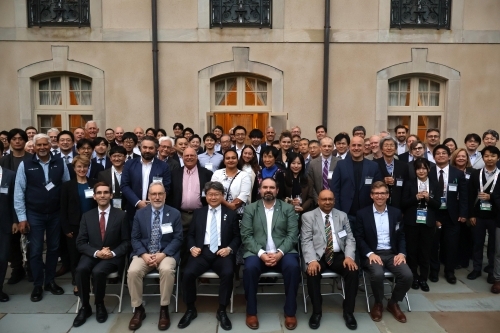
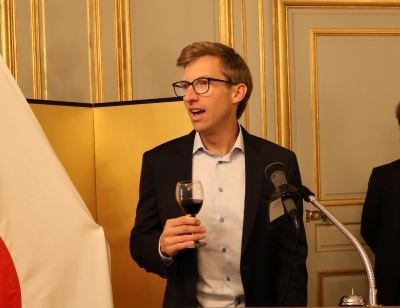
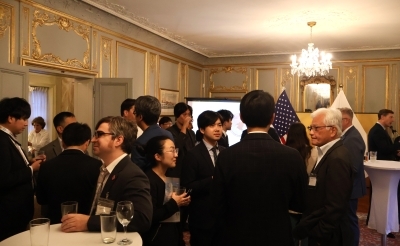
On September 29, Consul General Takahashi hosted the "JP-US Semiconductor & Microelectronics Reception" at the Consul General's Residence, taking advantage of the international semiconductor conference "IMAPS Symposium 2026" held in the area. The reception brought together Japanese and American stakeholders in the fields of semiconductors, microelectronics, and physical AI.
The event was attended by approximately 85 participants from a wide range of sectors spanning industry, academia, and government, including Benjamin Linvill-Engler, Deputy Director and Chief Investment Strategy Officer of the Massachusetts Technology Collaborative (MassTech Collaborative); Duane S. Boning, MIT Vice Provost for International Activities; Tomás Palacios, Director of MIT's Institute for Soldier Nanotechnologies (ISN) and Microsystems Technology Laboratories (MTL); and Avijit Banerjee, Senior Vice President for Research at the University of Connecticut, along with government officials, research institution representatives, researchers, and business leaders. The gathering fostered lively exchanges among all attendees.
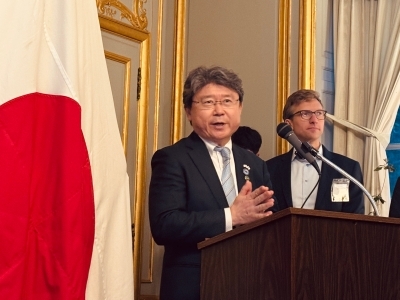
In his opening remarks, Consul General Takahashi highlighted the strategic importance of semiconductor and microelectronics technologies in the era of physical AI, emphasizing that packaging technologies integrating GPUs, HBM, and high-speed interconnects will be a defining key to next-generation innovation. He also spoke about the significance of the Japan-U.S. alliance and the role of J-NEXUS (Japan–New England Nexus for Innovation), an initiative launched by the Consulate General of Japan in Boston.
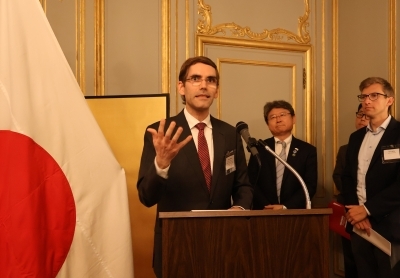
The guest of honor, MIT MTL/ISN Director Tomás Palacios, underscored the importance of international cooperation, noting that semiconductors and microelectronics underpin innovation not only in industries such as autonomous vehicles and 5G, but also in fields like intelligent healthcare. He further noted that by fostering collaboration between Japan's high-quality manufacturing capabilities and the United States' agile research and development capacity, there is significant potential to shorten future development and production timelines.
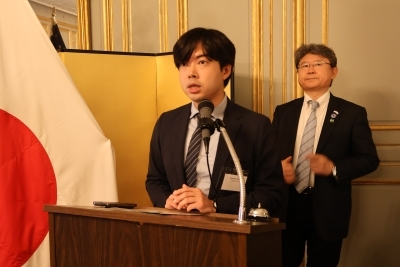
Soichiro Endo, Director of JETRO New York, then delivered a promotional presentation on SEMICON Japan 2026, scheduled to be held at Tokyo Big Sight from Wednesday, December 9 through Friday, December 11.
Finally, Professor Chris Miller of Tufts University — author of Chip War (2022), published in Japanese as Handotai Senso (2023) — shared his high expectations for the continued deepening of Japan-U.S. semiconductor cooperation and proposed a toast to all those in attendance.
The Consulate General of Japan in Boston remains committed to further strengthening the Japan-U.S. relationship, working in close partnership with all relevant stakeholders through the J-NEXUS platform, with the aim of developing an enduring partnership that is stronger, richer, more resilient, and more creative than ever before.